Performing Pictures

The magician-as-artist stands apart from the magician-as-trickster inasmuch as the former’s intention to deceive is plainly acknowledged beforehand, and conclusively reaffirmed in hindsight
Summary
Bio
References
PDF
Close
Discovered during a media-archeological investigation into optical illusions, trick photography, and discarded memorabilia, the photo-multigraph technique opened the door to an enchanted world of cloned appearances orbiting in a self-reflective solar system. Shapeshifting into our preferred artistic medium, this turn-of-the-century photographic technique becomes the video-multigraph. It is bizarrely noteworthy that self-isolation would become not only the subject of the piece, but also – due to the unforeseen spread of a recently mutated virus – the prevailing circumstances under which the work was to be completed. In Verfünfungseffekt, we use the medium of video to create a kaleidoscopic portrait-in-motion where the perspective-shifting shards of ego are recorded in a synchronized performance of solipsist intersubjectivity. The video-multigraph allows for the compositing of tiny offsets in time-shifting delays applied to one, or several, of the mirrored selves – shattering the cloned perfection, as well as the conformity, of the multiple presences. This optical illusion necessitates reflection on how media alters our perceptions of time and space; it thereby arouses wonder about our place in existence.
Keywords: Photo-multigraph, fivefold-portrait, mirror photography, video-multigraph, crisis of presence
- Keywords: crisis of presence, fivefold-portrait, mirror photography, Photo-multigraph, video-multigraph
Geska Helena Brečević (born 1975) and Robert Brečević (born 1971) form the artist duo Performing Pictures, founded in 2004. The couple is based in Stockholm, Sweden, and on the island of Rab in Croatia. Performing Pictures’ works center around memory and movement, linking language and moving images in ways that often require a viewer’s response. Their expanding body of video, pinhole camera animations, cinéapparitions, and casual snapshots blurs the lines between media forms, between still and moving images, and between ephemerality and permanence. In 2020, their book A postliminal script and explanatory notes on a film called Dreaming the Memories of Now will be published.
www.performingpictures.se
- De Martino, Ernesto. 1966. Sud e Magia, Milano: Feltrinelli.
- Reichstein, Irving. 2007. “A Multigraph from Montreal.” Photographic Canadiana, [online] 33 (1): 12–17. Available online here.
PDF format files of individual essays are priced at 3.00EUR. If you are subscribed to Membrana Online, you may purchase PDF access to all content on our site: Membrana PDF
(Online subscription is required!)
BUY PDF: G. Brecevic & R. Brecevic: Verfunfungseffekt – PDF
DOWNLOAD PDF:
All the more shall this become a memory of the time you and your mother stood on a countryside road amid the agave fields and with the mountain range of Oaxaca in the background on one of countless journeys...
Abstract
Bio
References
PDF
Close
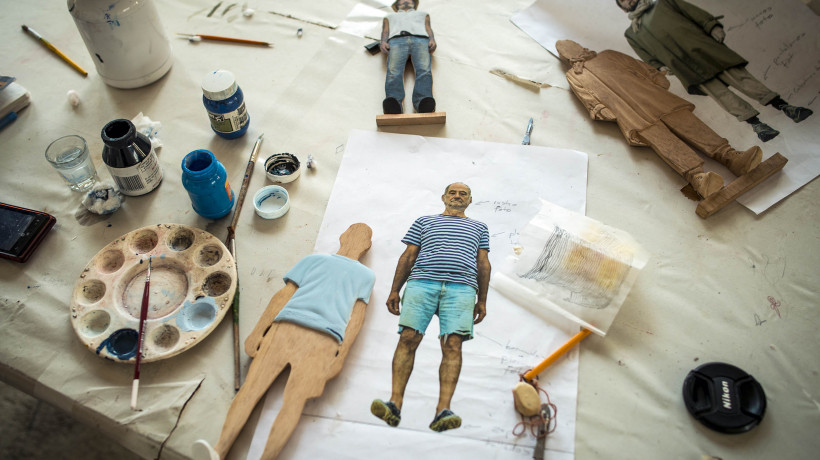
This essay traces the resurrection of the fotoescultura, a three-dimensional photographic portrait popular in rural Mexico in the early 20th century, as interpreted in recent works by Performing Pictures, a contemporary Swedish artist duo. The early fotoesculturas were an augmented form of portraiture, commissioned by family members who supplied photographs that artisans in Mexico City converted into framed sculptural portraits for display on family altars. We compare these »traditional« photographic objects with “new” digital forms of video animation on screen and in the public space that characterize Performing Pictures work, and explore how the fotoescultura inspired new incarnations of their series Men that Fall. At the intersection between the material aspects of a “traditional” vernacular art form and “new” media art, we identify a photographic aesthetic that shifts from seeing and perceiving to physical engagement, and discuss how the frame and its parergon augment the photographic gaze. The essay is accompanied by photos and video stills from Performing Pictures’ film poem Dreaming the Memories of Now (2018), depicting their work with the fotoesculturas.
- Keywords: fotoesculturas, frame, parergon, vernacular photography, videoart
Karin Becker is professor emerita of media studies at Stockholm University. Originally based in the US, her early research focused on documentary photography and photojournalism in the US and its European influences. She has investigated a broad range of visual media forms and practices, and has led major research projects on global media events and art installations as mediated through the public space. Visual ethnography has been central to her methodological approach. Since 2008, her research has included an ongoing study of Performing Pictures’ work in Sweden and southern Mexico. Becker is currently engaged in the research project Screening Protest (www.screeningprotest.com), where she is analysing the visual coverage of protests as mediated in transnational television news broadcasts.
Karin Becker: karin.becker@ims.su.se, Department of Media Studies, Stockholm University, Sweden
Geska Helena Brečević is an artist and independent researcher working mainly in Sweden, Mexico and Croatia. In 2004, she and Robert Brečević formed Performing Pictures (www.performingpictures.art). Together they make film and video installations that blur the lines between still and motion media. Their work, supported by numerous national and international grants, has resulted in more than 20 solo and 50 group shows as well as commissions for several permanent public art installations. Her artistic research has been carried out with the support of The National Arts Grants Committee, the Royal Institute of Arts and the National Swedish Research Committee. Geska is currently the artistic director of the Film Capital Stockholm’s project Smart Kreativ Stad (www.smartkreativstad.com) investigating new perspectives on moving images in the public space.
Geska Helena Brečević: geska@performingpictures.se, Performing Pictures, Sweden
- Batchen, G., 2001. Vernacular Photographies. In: Each Wild Idea: Writing, Photography, History. Cambridge MA: MIT Press, pp. 57–80. https://doi.org/10.7551/mitpress/2541.003.0004
- Day, D., 1998. A Survey of Frame History, Part 1: Panel Painting. Picture Framing Magazine, (August), pp. 82–84.
- Derrida, J., 1987. The Truth in Painting. Chicago: University of Chicago Press.
- Faludi, S., 1999. Stiffed: The Betrayal of the American Man. New York: William Morrow and Company.
- Garza, M., 1998. Fotoescultura: A Mexican Photographic Tradition. Albuquerque: University of New Mexico Art Museum.
- Garza, M., 2000. No me olvides: The Fotoescultura. A Mexican Photographic Tradition. Albuquerque: University of New Mexico Art Museum.
- Garza, M., 2002. Secular Santos. Afterimage, 29(6).
- Scheinman, P., 1996. Foto-escultura. Luna Córnea, pp. 97–101.
- Scheinman, P., 2000. Vernacular Photographies. History of Photography, 24(3), pp. 262–271.
- Williams, R., 1961. The Long Revolution. London: Chatto & Windus.
PDF format files of individual articles are priced at 6.00EUR. If you are subscribed to Membrana Online, you may purchase PDF access to all content on our site: Membrana PDF
(Online subscription is required!)