Ioan Daniel Mihalcea
Ioan Daniel Mihalcea is a Ph.D. Student at the Center of Excellence in Image Studies, University of Bucharest, the object of his research being Cultural Studies. His thesis is focused on the relationship between politics and aesthetics in documentary photography and photojournalism, especially in times of crisis and conflict. He is interested in how long-term documentary projects are re-imagined in the current digital environment, what visual tropes are articulated and how they contribute to the discourse of the visual public sphere. Starting 2018, he is an affiliated member of the International Association of Photography and Theory based in Cyprus. At present, he is a teaching assistant for the Photographic Image course at the Center of Excellence in Image Studies, where I concentrate on the prominent periods in photographic theory and its histories.
University of Bucharest, Center of Excellence in Image Studies
ioandanielmihalcea@gmail.com or ioan-daniel.mihalcea@drd.unibuc.ro
Every image of the past that is not recognized by the present as one of its own concerns threatens to disappear irretrievably.
Abstract
Bio
References
PDF
Close
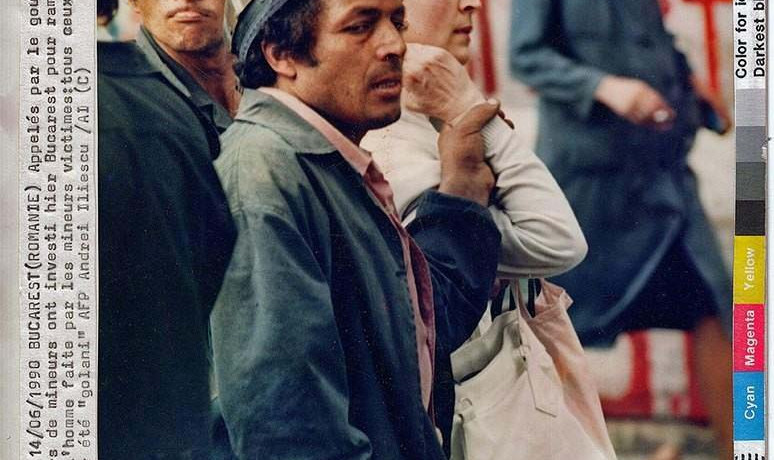
This paper investigates the conditions in which photojournalistic images of the past are becoming iconic and it also traces the ways in which such images actively negotiate the meanings of particular events. Starting from Robert Hariman and John Lucaites’ iconic photography methodology (2007), this research aims to clarify how iconicity operates in specific situations defined by cultural and digital circumstances. The proposed case study analyses the photographs of the events known as Miners’ Raids that took place in Bucharest, Romania in the aftermath of the December 1989 Revolution. First, through a close reading of the aesthetic qualities of the photographic composition, I investigate how images themselves are sites where meaning is produced and how they have the power to sustain multiple and sometimes contradictory semiotic transcriptions. Second, I trace the circulation and appropriation of these photographs to argue their capacity to generate debates and absorb new meanings in the course of their afterlives. The purpose is to understand how photography can work as a distinct category that can articulate complex ideas, judgments, and dialogue.
- Keywords: close reading, dissent, iconic photography, remobilization, Romanian public culture
Ioan Daniel Mihalcea is a Ph.D. Student at the Center of Excellence in Image Studies, University of Bucharest, the object of his research being Cultural Studies. His thesis is focused on the relationship between politics and aesthetics in documentary photography and photojournalism, especially in times of crisis and conflict. He is interested in how long-term documentary projects are re-imagined in the current digital environment, what visual tropes are articulated and how they contribute to the discourse of the visual public sphere. Starting 2018, he is an affiliated member of the International Association of Photography and Theory based in Cyprus. At present, he is a teaching assistant for the Photographic Image course at the Center of Excellence in Image Studies, where I concentrate on the prominent periods in photographic theory and its histories.
University of Bucharest, Center of Excellence in Image Studies
ioandanielmihalcea@gmail.com or ioan-daniel.mihalcea@drd.unibuc.ro
- Abraham, F. 2006. România de la comunism la capitalism 1989–2004. Sistemul politic. Bucharest: Tritonic.
- Alexander, J. C. 2008. “Iconic Experience in Art and Life: Surface/Depth Beginning with Giacometti’s Standing Woman.” Theory, Culture & Society 25 (5): 1–19. https://doi.org/10.1177/0263276408095213
- Azoulay, A. 2008. The Civil Contract of Photography. The MIT Press.
- Bârsan, V. 2015. Mineriada din Iunie. Bucharest: Editura Tractus Arte.
- Benjamin, W. 2007. Illuminations. Essays and Reflections. Edited by Hannah Arendt. New York: Schocken Books.
- Berindei, M. 2010. Mineriada 13-15 Iunie 1990. Realitatea unei puteri neocomuniste. Third edition. Humanitas.
- Boltanski, L. 1999. Distant Suffering: Morality, Media and Politics. Cambridge University Press.
- Boudana, S., Paul Frosh, in Akiba A. Cohen. 2017. “Reviving Icons to Death: When Historic Photographs Become Digital Memes.” Media, Culture & Society 39 (8): 1210–1230. https://doi.org/10.1177/0163443717690818
- Cesereanu, R. 2016. Imaginarul violent al românilor. Second edition. Bucharest: Editura Tactus Arte.
- Departamentului pentru analiza crimelor neocomunismului în România din cadrul Asociaţiei 21 Decembrie 1989. 2009. “Raport-rechizitoriu despre fratricidul din 13-15 iunie 1990.”
- Dorin, M. 2006. România de la comunism la mineriade. Institutul Cultural Român.
- Hariman, R. 2013. “Images of Protest in Istanbul: The Woman in Red.”
- Hariman, R. and John Louis Lucaites. 2007. No Caption Needed: Iconic Photographs, Public Culture, and Liberal Democracy. University of Chicago Press. https://doi.org/10.2752/175145108786279829
- Horta, P. 2013. “An Alternative Route for Considering Violence in Photography.” Photographies 6 (1): 71–81. https://doi.org/10.1080/17540763.2013.788839
- Jenkins, H. 2006. Convergence Culture: Where Old and New Media Collide. NYU Press.
- Kress, G. and Theo van Leeuwen. 2006. Reading Images: The Grammar of Visual Design. Routledge.
- Mitchell, W. J. T. 2011. Cloning Terror: The War of Images, 9/11 to the Present. University of Chicago Press.
- Mortensen, M. and Hans-Jörg Trenz. 2016. “Media Morality and Visual Icons in the Age of Social Media: Alan Kurdi and the Emergence of an Impromptu Public of Moral Spectatorship.” Javnost – The Public 23 (4): 343–62. https://doi.org/10.1080/13183222.2016.1247331
- Noble, A. 2010. “Recognizing Historical Injustice through Photography: Mexico 1968.” Theory, Culture & Society 27 (7–8): 184–213. https://doi.org/10.1177/0263276410383714
- Pușca, A. M. 2008. Revolution, Democratic Transition and Disillusionment: The Case of Romania. Manchester University Press.
- Rus, A. 2007. Mineriadele. Între manipulare politică și solidaritate muncitorească. Bucharest: Curtea Veche.
- Side, K. 2017. “Grimaldi’s Iconic Photograph: Bloody Sunday, Derry 1972.” Irish Journal of Sociology 26 (1): 71–93. https://doi.org/10.1177/0791603517741072
- Tismaneanu, V. 1993. “The Quasi-revolution and its Discontents. Emerging Political Pluralism in Post-Ceausescu Romania.” East European Politics and Societies 7 (2). https://doi.org/10.1177/0888325493007002005
- Zelizer, B. 2010. About to Die: How News Images Move the Public. Oxford University Press.
PDF format files of individual articles are priced at 6.00EUR. If you are subscribed to Membrana Online, you may purchase PDF access to all content on our site: Membrana PDF
(Online subscription is required!)