Karin Becker
Karin Becker is professor emerita of media studies at Stockholm University. She has held positions at Indiana University (Ph.D. 1976), University of Iowa, Konstfack/College of Art and Design (Stockholm) and Linköping University. She has been a Fulbright Senior Scholar at the University of Munich (1983) and Stockholm University (1988). In 2012-2014 she led the Nordic Network of Digital Visuality (NNDV). Her research centers on visual media forms and practices, including documentary photography and photojournalism, vernacular photography, and artistic and performative practices in public space. She has led research projects on public art (Konst genom staden, VR 2006-2008) and on global media events as mediated through public space (Changing Places, VR 2010-2014). Her recent work includes analyzing protest images in global television news within the research project Screening protest (www.screeningprotest.com).
Karin Becker: karin.becker@ims.su.se, Department of Media Studies, Stockholm University, Sweden
Images of protesters in the photo essay, linked to their own words, lend support to the legitimacy of their demands and their status as citizens, in ways news broadcasts of these events rarely achieve.
Abstract
Bio
References
PDF
Close
The photo essay, a form of visual journalism that arose during the era of the picture magazines, has reemerged as a regular feature of global news channels, including CNN, BBC World, and, notably, Al Jazeera English, recognized for its live reporting of political unrest. In 2017, a year marked by protest around the world, AJE published over 200 photo-series, including 37 on public protest. An analysis based in a four-year study of protest on screen, revealed that these photo essays share characteristics that in turn distinguish them from video broadcasts of public protests. The photo-reportage on screen, like its classic forerunner in print, employs a variety of visual perspectives and focuses on participants who are often quoted and identified by name. Scenes of public protest are complemented by visual and textual reporting from the private/domestic sphere. This visual strategy, in contrast to the immediacy of video coverage from the streets, supports knowledge of the protest issue and engagement with its participants.
- Keywords: Al Jazeera English, global television news, news galleries, photo essay, photojournalism, public protest
Karin Becker is professor emerita of media studies at Stockholm University. She has held positions at Indiana University (Ph.D. 1976), University of Iowa, Konstfack/College of Art and Design (Stockholm) and Linköping University. She has been a Fulbright Senior Scholar at the University of Munich (1983) and Stockholm University (1988). In 2012-2014 she led the Nordic Network of Digital Visuality (NNDV). Her research centers on visual media forms and practices, including documentary photography and photojournalism, vernacular photography, and artistic and performative practices in public space. She has led research projects on public art (Konst genom staden, VR 2006-2008) and on global media events as mediated through public space (Changing Places, VR 2010-2014). Her recent work includes analyzing protest images in global television news within the research project Screening protest (www.screeningprotest.com).
Karin Becker: karin.becker@ims.su.se, Department of Media Studies, Stockholm University, Sweden
- Becker, K. 1985. »Forming a Profession: Ethical Implications of Photojournalistic Practice on German Picture Magazines, 1926-1933.« Studies in Visual Communication 11/2: 44–60. https://doi.org/10.1111/j.2326-8492.1985.tb00023.x
- Becker, Karin. 2018. »Icons of Protest in the Visual Cultures of News.« In Screening Protest: Visual narratives of dissent across time, space and genre, ed. A. Robertson. London & New York: Routledge. https://doi.org/10.4324/9781315173894-6
- Caple, H. and John Knox. 2012. »Online News Galleries, Photojournalism and the Photo Essay.« Visual Communication, 11(2): 207–236. https://doi.org/10.1177/1470357211434032
- Robertson, A., Luiza Chiroiu and Diana Grecu. 2018. »Protest on global television: protest maps, violence and voice.« In Screening Protest: Visual narratives of dissent across time, space and genre, ed. A. Robertson. London & New York: Routledge. https://doi.org/10.4324/9781315173894-2
- Robertson, A., ed. 2018. Screening Protest: Visual narratives of dissent across time, space and genre. London & New York: Routledge https://doi.org/10.4324/9781315173894
- Solaroli, M. 2016. »The Rules of a Middle-brow art: Digital production and cultural consecration in the global field of professional photojournalism.« Poetics 59 (december): 50–66. http://dx.doi.org/10.1016/j.poetic.2016.09.001
Sources (projects and photo essays)
- aljazeera.com. In Pictures. 2017. Includes photographer’s name, date, headline and lead-in text. Accessed 13 June 2019, aljazeera.com, adding filter “In Pictures” and scrolling back to 2017 and the date.
- 20170116. Shafi, Showkat. 16 Jan. In the name of Ram: Tattoos in India’s Dalit community. After being denied access to temples, some Dalits began tattooing the name of the Hindu god Ram on their face and body.
- 20170122a. Lunde, Kelly Lynn. 22 Jan. Washington DC: Women’s March for equal rights. “I came to show solidarity with women and all the other people who resist the bigotry and … intolerance.”
- 20170122b. (Compilation) 22 Jan. Women marches across the world draw huge crowd. Hundreds of thousands join women’s marches to protest new US president’s stance on gender, minorities and human rights.
- 20170202. Moldovan, Ioana. 2 Feb. Protests surge as Romania decriminalises corruption Hundreds of thousands decry measures that decriminalise graft offences as judicial watchdog announces court challenge.
- 20170203. Lunde, Kelly Lynn. 3 Feb. NYC Yemenis close bodegas to protest Trump travel ban Strike supported by more than 2,000 people aimed to highlight the role of immigrant labour in the city.
- 20170206a. Moldovan, Ioana. 6 Feb. Romania Protests: A family’s fight. A day in the life of a Romanian family who are taking to the streets each night for the future of their children.
- 20170206b. Dijkstra, Andrea, & Jeroen Van Loon. 6 Feb. Kenya’s Maasai and Samburu becoming women without FGM. “When my parents called the [cutter for my sister], I warned the district officer. Our generation can bring change.”
- 20170217. (Compilation). 17 Feb. US immigrants stay at home to demonstrate their value. Thousands participated in the protests across United States.
- 20170327. Zanoun, Ezz. 27 March. “Thousands attend Gaza funeral of slain Hamas official. Palestinians poured into the streets on Saturday for the funeral of Mazen Faqha”.
- 20170427. Khan, Faisal. 27 April. Female Kashmiri students lead anti-India protests. Students from various female colleges in Indian administered Kashmir take part in mass protests against Indian soldiers.
- 20170602. Porter, Lizzie (writer), & Leila Molana-Allen (photographer). 2 June. Walking a path of resistance in Palestine. Illegal Israeli settlements surround the Masar Ibrahim trail on all sides.
- 20170616. Zanoun, Ezz. 16 June. Mass protests on Gaza’s borders over electricity crisis. Palestinians in besieged Gaza Strip protest at borders with Israel as rights groups warn of growing humanitarian crisis.
- 20170701. Zanoun, Ezz. 1 July. Life in the darkness of Gaza’s power crisis. Palestinians in the besieged territory are receiving just a few hours of electricity a day.
- 20170721. (Compilation). 21 July. Al-Aqsa: Clashes in Jerusalem’s Old City. At least three Palestinians killed and over a hundred protesters injured in clashes over the al-Aqsa Mosque controversy.
- 20170815a. (Compilation). 15 Aug. India celebrates Independence Day. Indians mark the day they gained freedom from British colonial rule in 1947.
- 20170815b. Chao, Steve. 15 Aug. Seventy years of India–Pakistan partition in pictures. Seventy years on, partition and the violence that accompanied it continues to shape India and Pakistan.
- 20170828. Lunde, Kelly Lynn. 28 Aug. US anti-racists counter Hate. Thousands respond to right wing rallies planned in San Francisco and Berkeley, claiming victory as marches cancelled.
- 20170903 Glanowski, Sara Maria. 3 Sept. “Inside Afropunk: The most inclusive space in the US?”
- 20171101. Baxter, Will. 1 Nov. Kenya election: Without dialogue “we will all perish”. At least 50 people have been killed in political violence in Kenya since August’s annulled poll.
PDF format files of individual articles are priced at 6.00EUR. If you are subscribed to Membrana Online, you may purchase PDF access to all content on our site: Membrana PDF
(Online subscription is required!)
BUY PDF: Karin Becker: Protest in the Photo Essay – PDF
DOWNLOAD PDF:
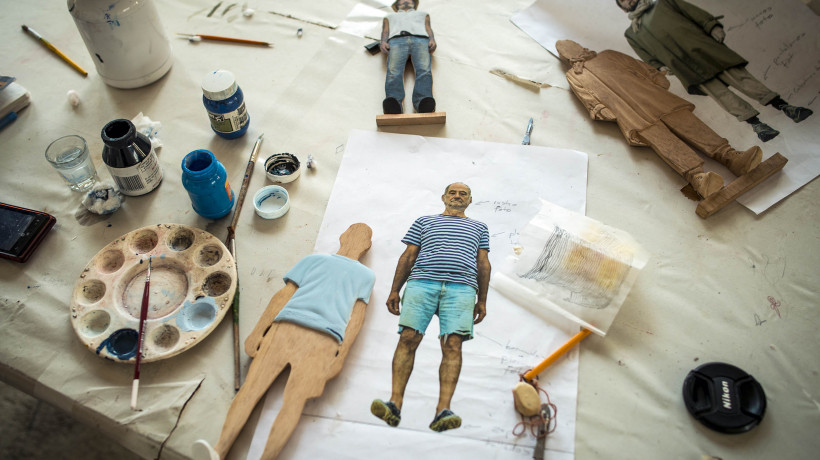
All the more shall this become a memory of the time you and your mother stood on a countryside road amid the agave fields and with the mountain range of Oaxaca in the background on one of countless journeys...
Abstract
Bio
References
PDF
Close
This essay traces the resurrection of the fotoescultura, a three-dimensional photographic portrait popular in rural Mexico in the early 20th century, as interpreted in recent works by Performing Pictures, a contemporary Swedish artist duo. The early fotoesculturas were an augmented form of portraiture, commissioned by family members who supplied photographs that artisans in Mexico City converted into framed sculptural portraits for display on family altars. We compare these »traditional« photographic objects with “new” digital forms of video animation on screen and in the public space that characterize Performing Pictures work, and explore how the fotoescultura inspired new incarnations of their series Men that Fall. At the intersection between the material aspects of a “traditional” vernacular art form and “new” media art, we identify a photographic aesthetic that shifts from seeing and perceiving to physical engagement, and discuss how the frame and its parergon augment the photographic gaze. The essay is accompanied by photos and video stills from Performing Pictures’ film poem Dreaming the Memories of Now (2018), depicting their work with the fotoesculturas.
- Keywords: fotoesculturas, frame, parergon, vernacular photography, videoart
Karin Becker is professor emerita of media studies at Stockholm University. Originally based in the US, her early research focused on documentary photography and photojournalism in the US and its European influences. She has investigated a broad range of visual media forms and practices, and has led major research projects on global media events and art installations as mediated through the public space. Visual ethnography has been central to her methodological approach. Since 2008, her research has included an ongoing study of Performing Pictures’ work in Sweden and southern Mexico. Becker is currently engaged in the research project Screening Protest (www.screeningprotest.com), where she is analysing the visual coverage of protests as mediated in transnational television news broadcasts.
Karin Becker: karin.becker@ims.su.se, Department of Media Studies, Stockholm University, Sweden
Geska Helena Brečević is an artist and independent researcher working mainly in Sweden, Mexico and Croatia. In 2004, she and Robert Brečević formed Performing Pictures (www.performingpictures.art). Together they make film and video installations that blur the lines between still and motion media. Their work, supported by numerous national and international grants, has resulted in more than 20 solo and 50 group shows as well as commissions for several permanent public art installations. Her artistic research has been carried out with the support of The National Arts Grants Committee, the Royal Institute of Arts and the National Swedish Research Committee. Geska is currently the artistic director of the Film Capital Stockholm’s project Smart Kreativ Stad (www.smartkreativstad.com) investigating new perspectives on moving images in the public space.
Geska Helena Brečević: geska@performingpictures.se, Performing Pictures, Sweden
- Batchen, G., 2001. Vernacular Photographies. In: Each Wild Idea: Writing, Photography, History. Cambridge MA: MIT Press, pp. 57–80. https://doi.org/10.7551/mitpress/2541.003.0004
- Day, D., 1998. A Survey of Frame History, Part 1: Panel Painting. Picture Framing Magazine, (August), pp. 82–84.
- Derrida, J., 1987. The Truth in Painting. Chicago: University of Chicago Press.
- Faludi, S., 1999. Stiffed: The Betrayal of the American Man. New York: William Morrow and Company.
- Garza, M., 1998. Fotoescultura: A Mexican Photographic Tradition. Albuquerque: University of New Mexico Art Museum.
- Garza, M., 2000. No me olvides: The Fotoescultura. A Mexican Photographic Tradition. Albuquerque: University of New Mexico Art Museum.
- Garza, M., 2002. Secular Santos. Afterimage, 29(6).
- Scheinman, P., 1996. Foto-escultura. Luna Córnea, pp. 97–101.
- Scheinman, P., 2000. Vernacular Photographies. History of Photography, 24(3), pp. 262–271.
- Williams, R., 1961. The Long Revolution. London: Chatto & Windus.
PDF format files of individual articles are priced at 6.00EUR. If you are subscribed to Membrana Online, you may purchase PDF access to all content on our site: Membrana PDF
(Online subscription is required!)